
By Carmelo Garcia – Local Democray Reporter
Gloucestershire is approaching a “defining moment” in its history as options for how local government is set up in the county will be put forward to ministers next month.
It is likely that three options on how a council shake-up could unfold will be submitted to the Government.
Gloucestershire County Council along with the six district authorities have worked together to come up with two proposals for how local government could be organised in the future.
These are for one single unitary authority, splitting the county into East and West with one council made up of Gloucester, the Forest of Dean and Stroud and the other composed of Cheltenham, Cotswold and Tewkesbury.
And a Greater Gloucester unitary council with a separate unitary for the rest of the county being put forward by the City Council.
Councillors across the county will discuss these options and the final proposals must be submitted to the Government by November 28.
A public consultation on the proposals is expected early next year before ministers decide in the summer which option they want to see implemented in Gloucestershire.
Politicians in the county are split on party and geographic lines across the county and it is likely that three options will be put forward for the Government to consider.
Shire Hall leader Lisa Spivey (LD, South Cerney), who is currently undecided on her preferred option, says one of her top priorities has been to get all the council chiefs and senior officers to work together on the single unitary and the East/West split options.
She says it has been a “very intensive” process and the group have “worked together in a very collegiate fashion, respecting that there are some strong views for each option”.
“We have had some robust and challenging conversations, but it has been a really rewarding experience,” she said.
“Everyone has been focussed on making the options as good as they can be so that whatever happens, residents of Gloucestershire and our businesses, will continue to receive the level of services they deserve and expect.
“From talking to colleagues going through local government reorganisation in other counties, I know that this has not been the case in other places, so I am really glad that we have made this work.
“We now have both options written up in full and are commencing the democratic process of taking them through our respective councils, with the County Council’s meeting on November 12.”
Cllr Spivey says she can see merit in both of the options being developed by the County Council.
“The key in either model is ensuring that the voices of town and parish councils, and our residents, is not lost in big, faceless organisations,” she said.
“We must make sure that the ‘local’ in local government is front and centre.
“I’ll be listening closely to the debate on November 12 and making my final decision after that.”
Reform UK, who lead the opposition at Shire Hall, have confirmed their intention is to vote for a single unitary authority.
They say they are fundamentally opposed to the entire process of local government reorganisation but will cast a tactical vote in favour of the single council to prevent the fragmentation of the county into a significantly more damaging and expensive two-unitary system.
Group leader Vernon Smith (R, Tewkesbury West) said: “Our hands are tied by political division.
“While the Liberal and Green groups remain divided, the council risks failing to unite behind a single, consistent proposal.
“This division has created a dangerous vacuum where the default outcome could be the imposition of a costly, second-rate two-unitary system, effectively tearing our county in half.
“Let us be absolutely clear: our vote for the Single Unitary Authority is a critical, defensive measure. It is a necessary evil to prevent a greater financial and logistical catastrophe from being inflicted upon the communities of Gloucestershire.”
The Green Party group at Shire Hall say it is too early to be sharing their final position.
However, their nine county councillors are not whipped and will be free to vote according to their own views on the day.
The Conservatives, who have consistently advocated for one single unitary council, say ‘One Gloucestershire’ is the only option if the focus is for cost efficient services.
“It makes financial sense where splitting Gloucestershire would include splitting key services like Adults and Children’s care,” group leader Stephen Davies (C, Hardwicke and Severn)
“It is an indication of the weak leadership of this Liberal Democrat administration that they can’t provide leadership on this and are sitting on the fence.”
Tewkesbury Borough Council’s Liberal Democrat leader Richard Stanley (LD, Cleeve West), who is also a County Councillor, is another strong supporter of the single unitary option.
His authority will be formally reviewing the proposals at the Borough Council meeting in November 18 and could be submitting one of the options to the Government.
“While Local Government Reorganisations has been imposed by government, it does offer us an opportunity to rethink how local government works in Gloucestershire,” he said.
“As part of this transition, we will want to ensure services are designed in a way that are more efficient, quicker to respond, but that still feel local to the people who use them.
“For Tewkesbury Borough, it’s important that any future structure ensures our communities and businesses continue to thrive.”
City Council’s Liberal Democrat leader Jeremy Hilton (LD, Kingsholm and Wotton) says all three options deserve serious consideration.
But he believes the Greater Gloucester model will be best to reflect the historic city’s identity and ambitions.
“This is a defining moment for local government in Gloucestershire,” he said.
“There are three options that will be ready for submission to the government.
“The third option is the Greater Gloucester model, which is being finalised right now. This provides for a unitary council focused on the city of Gloucester and the surrounding parishes and another unitary council to serve the rest of the county.
“All three options deserve serious consideration, but the Greater Gloucester model is the only one that gives our historic city and surrounding parishes a council of their own. One that reflects the city’s distinct identity, ambition and current momentum.
“Gloucester is transforming, and any new structure must support that progress, not stall it.
“We’ll be reviewing the proposals in full at our council meeting on November 20, and we’re committed to working constructively with partners to shape a future that delivers for all our communities.”
Cheltenham Borough Council leader Rowena Hay (LD, Oakley), who is among the main supporters of two unitary authorities for the county, believes this option will mean local democracy is closer to the people.
Initially, the two new unitary authorities would be based on the districts of Cheltenham, Cotswold and Tewkesbury in the eastand Gloucester, the Forest of Dean and Stroud in the West.
But it will be important that the government undertakes a a boundary review at some point if they go ahead with those plans.
“If what they decide is two is better than one, then it makes absolute sense to have a boundary review,” Cllr Hay said.
“I’m ambitious for Cheltenham and for Gloucestershire, and it’s a vital part of the process that we create genuine collaboration as we set out our proposals for a way forward.
“I’m glad that we’ve managed to be able to work with the County Council and that we’ve done this in a much more collaborative way.
“But we all also need to recognise that each authority will have a view, as is right in the democratic process. We are mandated to represent the population of Cheltenham.
“Bigger is not always better. And we’re not looking at the next five years, we’ve got a once in a generation opportunity to do things differently that actually make it easier and better for people, not just about finances.
“Two unitaries are better than one. It’s closer, it’s closer to the people.”
County Council chairman Steve Robinson (L, Nailsworth), Labour’s only councillor at Shire Hall, also believes the smaller the unitary the more local it will feel for most.
“Most residents don’t really know what the different councils are responsible for, so having one council makes sense,” he said.
“Whether it’s one or two unitary authorities there are pro and cons for both.
“The smaller the unitary, I guess, the more local it will feel for our residents”
The options
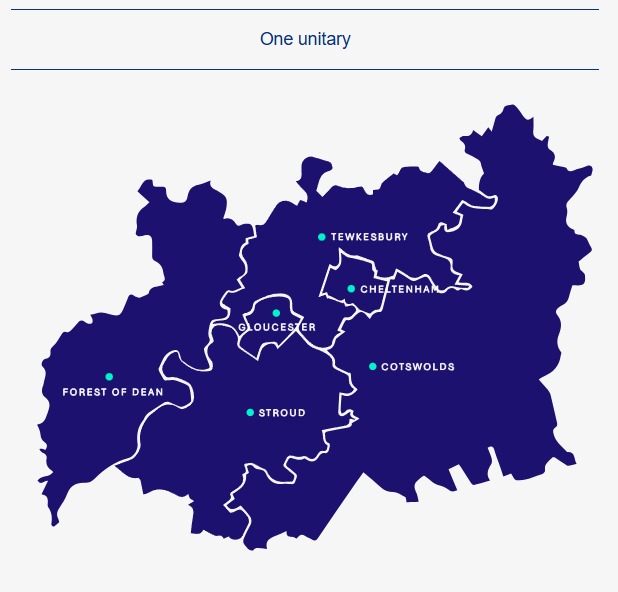
A single unitary council:
One council for the whole of Gloucestershire County Council area.
Would maintain the current county-wide approach to delivering fire and rescue services, adult social care, children’s social care and education services.
Aims to make decisions quicker, cut out repeated work, and provide better, more consistent services.
Expected to save more than £21 million per year, with £164 million in net savings over the next 10 years.
Local communities would have more say through new Neighbourhood Partnerships and links with town and parish councils.
Would invest in digital technology to make services easier to use.
Meets Government requirements and puts Gloucestershire in a strong position for future changes.
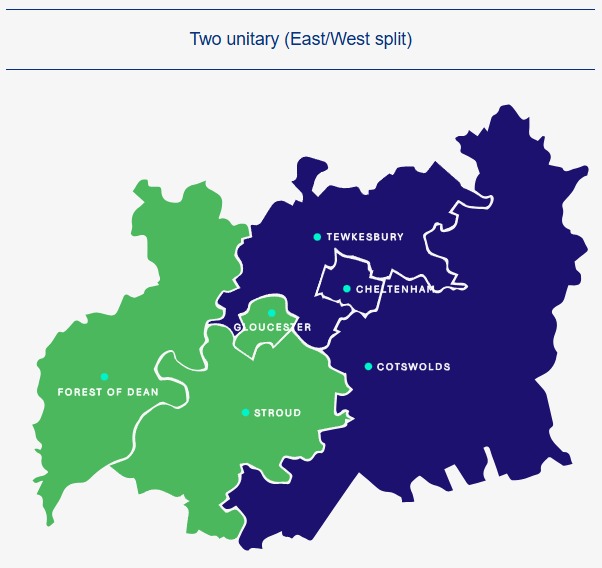
Two unitary councils:
Two councils: one for the East made up of the current Cotswold district and boroughs of Cheltenham and Tewkesbury and one for the West covering Gloucester, the Forest of Dean and Stroud.
Keeps a strong local identity for different parts of the county.
Expected to save nearly £11 million a year, with more than £55 million saved in ten years.
Local people would have more say through Neighbourhood Partnerships and links with town and parish councils.
Both councils would invest in digital technology for better services.
Meets Government requirements and supports Gloucestershire’s ambitions.

Greater Gloucester:
Two councils: One made up of an expanded city area called Greater Gloucester and another unitary which would cover the rest of the county
Gives historic city of Gloucester and surrounding parishes a council of their own
Reflects the city’s distinct identity, ambition and current momentum
Based on the Government’s current timetable, elections to the new council or councils would be in May 2027 with the new authority taking over from the current seven councils from April 2028.