
By Carmelo Garcia – Local Democracy Reporter
There is concern a £4m dredging plan to solve the Gloucester Docks silt crisis may not be enough.
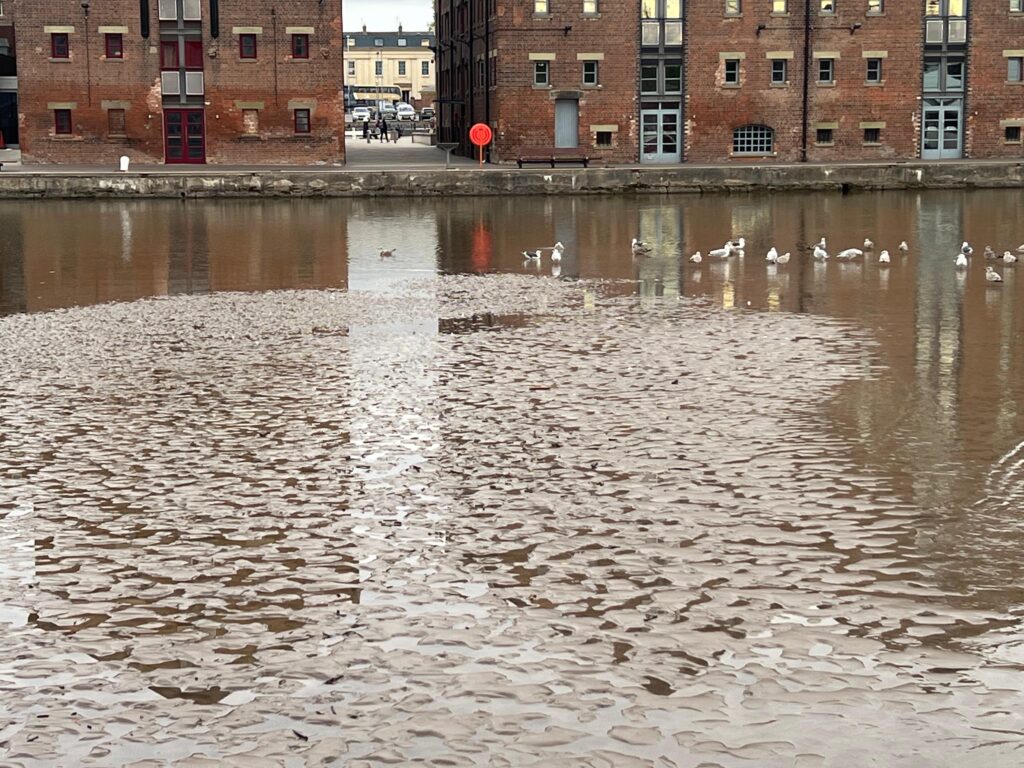
The amount of silt in the Gloucester and Sharpness Canal has increased so much it protrudes above the water in Main Basin, drawing a comparison with its famously muddy seaside neighbour Weston-super-Mare.
The build-up of silt has got progressively worse in recent times, making it difficult for vessels to access the Docks.
The main cause of silt ingress is due to water being pumped from the River Severn into The Docks. This is done to supply Bristol with around half of its drinking water.
The Canal and River Trust has a long term contract with Bristol Water, which is not deemed to be very favourable for the waterways charity.
And they have recently announced they would be spending an extra £2m, doubling its dredging budget to £4m in response to the significant build-up of silt.
The enhanced programme, which began on October 5, aims to increase navigation depths, support boaters and waterside businesses, and help safeguard Gloucester Docks’ role as one of the region’s most important leisure, tourism and heritage destinations.
Alongside dredging, the trust will explore further measures that could be taken to reduce future silt coming in from the River Severn and improve the long-term resilience of the Docks.
But former city mayor Chris Witts, an author of books on the River Severn who spent years working on tanker barges, questions how the Canal and River Trust will solve the problem.
He believes the Docks would be in a better situation if it had more commercial traffic and believes a better solution would be for the silt to be dumped in the Severn Estuary.
“They’ve got themselves into a mess,” he said. “It didn’t happen that many years ago.
“The Docks are not being used for what they were built for. It’s not got the commercial traffic.
“We don’t get the big vessels that used to push all this silt out of the way. It wouldn’t have had the chance to settle.
“They need to get a vessel with a big propeller and about once every two weeks just drive it round and round the docks stirring up the mud and it wouldn’t settle.
“And when they opened the lock gates to let the vessels out it would go out with them.”
He said the silt is being allowed to settle at the moment and he believes permission should be sought to extract the silt and dump it in the River Severn.
Environmental rules banning such a practice came into effect in 2000.
“I don’t know how they are going to get rid of that mud. They were using lorries last time. It’s not going to work with lorries, I don’t believe it.
“They need to get a bigger vessel than they use, fill it up and have about three of them and run them out into the mouth of the Severn Estuary and dump it there. They need to get permission to dump it back in the river.”
He also said the amount of silt that has accumulated in the Docks makes Gloucester seem like a seaside resort like Weston-super-Mare.
He described: “I was down at the Docks and they were pumping in water from the pumps this morning (October 6).
“It was like being at Weston, with the water coming in and lapping against the pile of mud. It was like being at the seaside.”
The Canal and River Trust, which cares for Gloucester Docks as part of its charitable work across England and Wales, says securing extra funding for a project of this scale has been challenging.
But they believe the investment is essential given the importance of the Docks to the city and region.
“Our dredging teams have been mobilising this week as the next phase of dredging at Gloucester Docks gets underway as part of our charity’s £4 million investment to restore navigable depths,” a spokesperson said.
“The suggestion of using a vessel with a large propeller to stir up sediment is similar to cutter suction dredging, a method we’ve previously used to remove silt from the Docks. While this approach can allow sediment to be returned to the river, strict environmental regulations and the protected status of the Severn Estuary dictate when this is possible.
“Instead, material removed during this phase is being transported by barge to Parkend for storage before being spread on agricultural land, while some will also be taken by lorry to recycling facilities.
“We are supportive of freight traffic and at Sharpness, ship movement remains robust. However, on narrower inland routes, traffic is now largely by leisure craft.”