
By Carmelo Garcia – Local Democracy Reporter
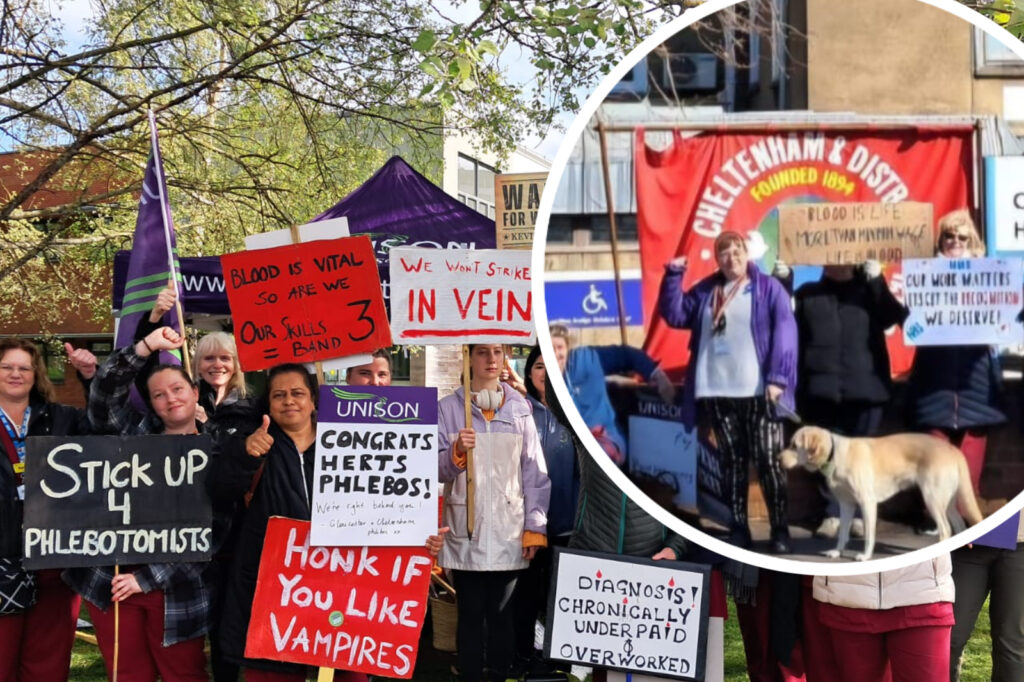
Dozens of specialist healthcare workers at Gloucestershire Royal and Cheltenham General hospitals are on course to go into their sixth week of strike action in their campaign for fair pay, say union officials.
The 37 phlebotomists, who take vital patient blood samples, say they have undertaken industrial action after Gloucestershire Hospitals NHS Foundation Trust failed to resolve a long-running dispute over pay and grading.
The current set of walkouts, which is the fifth week, is planned to continue until this Sunday, April 20.
But union officials say a lack of negotiations with the trust could see the strike extended into its sixth week.
Phlebotomists first raised concerns about their pay in March 2024 and submitted a formal complaint in September. Despite this, UNISON says the trust has yet to convene a formal meeting to review the problem.
They claim the trust has ignored a fair job-evaluation process and attempted to avoid its obligation to properly assess the phlebotomists’ skills and responsibilities, the union says. This is something the trust refutes.
UNISON claims that despite clear evidence the staff should be on band three of the NHS Agenda for Change pay scale, the trust’s managers continue to pay them at the lower band two grade, meaning they are losing out on around £1 per hour, adds the union.
Hospital bosses however say it is not accurate to suggest the phlebotomists are underpaid.
UNISON south west regional organiser Christopher Roche said: “Gloucestershire Hospitals NHS Foundation Trust is systematically underpaying dedicated frontline NHS workers. These specialist staff are currently paid the minimum wage of £12.21 per hour.
“The buck stops with the trust’s managers. They’ve had months to put things right – and failed. Hospital executives claim they’re working with staff to resolve these issues, but that is simply untrue. The only scheduled meeting with senior managers was cancelled at short notice and without explanation.
“Patients and NHS workers deserve much better than this. The trust needs to talk to its staff, pay them what they’re owed, and bring an end to this dispute.”
Phlebotomist Dawny Elliott said the way bosses are treating them is “unforgiveable”.
“Managers have little concept of what it’s like to earn the minimum wage,” she said.
“It’s not easy to get by. We’re skilled NHS staff, committed to our patients, and all we’re asking for is to be paid properly and fairly.”
Gloucester’s Labour MP Alex McIntyre has met with the striking workers and hospital bosses. He says he knows the fantastic work the phlebotomists do at the hospital and is encouraging all parties to talk.
“I’ve met recently with Unison and some of the phlebotomists who are taking part in the current strike action, as well as representatives from Gloucestershire Royal Hospital,” he said.
“I know what fantastic work the phlebotomy team at GRH do. Resolving this situation is also vital to continuing the Trust’s good work cutting waiting lists, an area in which they are already making great progress.
“Both sides want to find a solution to this situation and I am encouraging all parties to keep the conversation going.
A Gloucestershire Hospitals NHS Foundation Trust spokesperson said other local health services follow the same national job descriptions and pay the same as they do for phlebotomists.
“All NHS Agenda for Change roles are matched to national job descriptions, which have been developed with unions, and are regularly reviewed,” they said.
“Our phlebotomist’s job description matches the national profile, which is a Band two.
“It is not accurate to suggest the Trust has underpaid our Phlebotomists when they are paid in line with the national profile.
“Other local health services also follow the same national job descriptions and pay the same as we do for phlebotomist roles.
“We have encouraged UNISON to highlight any changes they believe should be made to the job description for our Phlebotomist roles. However, they have reshared the national profile job description and suggested that the banding has been incorrectly applied, which is not the case.”