
By Carmelo Garcia – Local Democracy Reporter
The much-needed revamp of Gloucestershire Royal Hospital’s outdated tower block could take up to four years to complete prompting concerns it could put pressure on the wider health system.
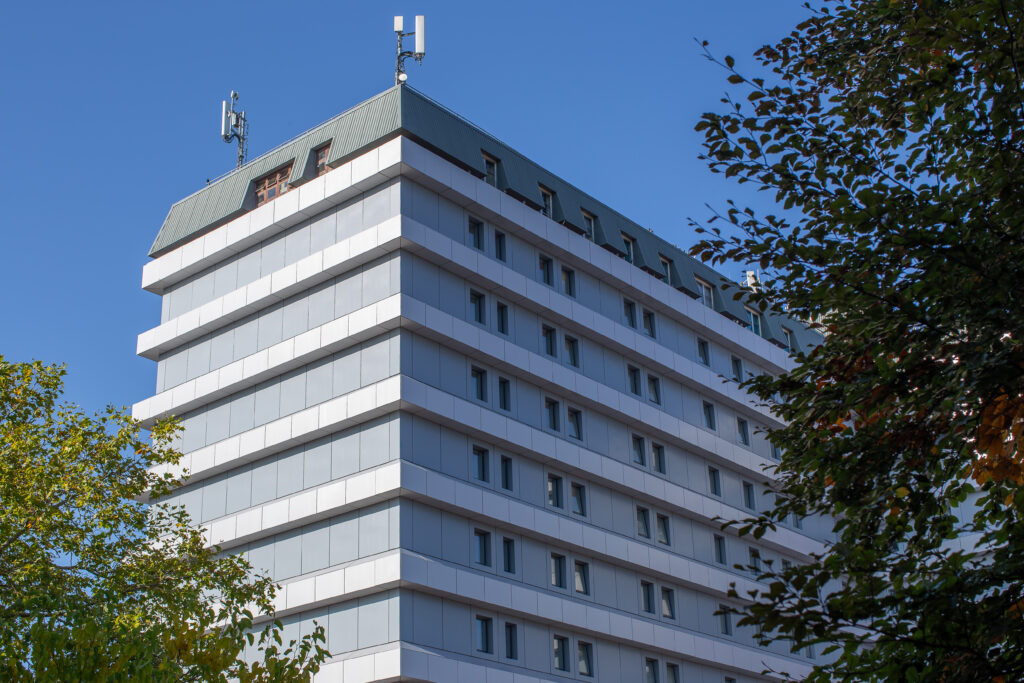
The 11-storey tower block has undergone a facelift and been wrapped in two-toned facade panelling.
However, hospital bosses say a review during these works found there is a need to upgrade the wards on each of the floors.
The outdated fire safety infrastructure will be replaced and cosmetic work undertaken on each level of the tower.
To do this, each ward will have to be decanted.
And the plan is to empty two wards on a floor of the tower and to use this as a decant space which would allow contractors to upgrade two wards one floor at a time.
Each floor is expected to take around four to six months to complete and the overall estimate for completion is around three to four years to complete the tower wards.
Neurology services including the neurology ward, brain injury and neuro therapy will be moved from Gloucester to the Prescott ward at Cheltenham General Hospital until the work is complete.
And three wards will be reconfigured provisioning vascular, endocrine and general medical services, to create a combined vascular and endocrine ward, a general medicine ward and release a ward to be used as a decant ward.
The move will be helped by a programme to support around 35 patients who are fit to leave hospital to be sent home or to a community hospital.
Councillor Adrian Bamford (LD, Up Hatherley), a former operations director at Gloucestershire Hospitals NHSFT who does part time work for the trust, apologised that the tower was not demolished and rebuilt previously.
He also raised concerns at the health overview and scrutiny committee that the closure of wards would put pressure on the healthcare system.
“First of all, an apology really,” he said.
“Just 25 years ago, we fully appreciated the issues in that tower block and actually considered whether we could actually rebuild it and demolish the existing building.
“That’s really how bad it is. So, I’m glad you’re finally able to bite the bullet and clearly this is work that desperately needs doing.
“But there is a concern on this side of the chamber because when beds are closed like that it creates all sorts of pressures on the healthcare system.
“Ideally, those 35 beds will be replaced somewhere.
“I’m delighted the community hospitals are looking to step up their game, particularly in Cirencester.
“That will help but it will create a hell of a lot of pressure.”
Chief operating officer Al Sheward told the meeting at Shire Hall that the external rain proof cladding has been added to the tower.
And they have undertaken a survey of the 50 year old tower.
“It was built with a lifespan of about 30 years,” he said. “So it has served more and beyond what it was intended to do.
“Our current plan is to replace some of the outdated fire infrastructure system in the Gloucester tower.
“Much of this learning came from the Grenfell Inquiry where we learnt an awful lot about how to manage and maintain safe multiple rise buildings.
“Within the tower, each ward will undergo upgrades. There are plans to improve infrastructure like the nurse call bell system, oxygen supply, fire detection and prevention systems.”
He said to do that the wards need to be empty.
“Not all of them you’ll be pleased to hear but at least two of them,” he added.
Building experts have advised the trust the best and quickest way to do the work would be to offer a decant floor, he said.
“Out of the 11 floors we clear one floor at a time and there’s approximately two wards on every floor in the tower,” he said.
“During the time that shoe wards are empty we would undertake not only the essential work but we would also undertake cosmetic work to improve the wards which are looking very dated.”
He said the work would take three to four years to complete.
“Firstly our plan is to move on a temporary basis neurology services from Gloucester Royal to Prescott ward at Cheltenham General Hospital,” he said.
“We’ll then undertake a three ward configuration within the tower that encompasses our vascular and endocrine ward and the creation of a general medical ward.
“This will free up at least one ward in the tower.
“Then with the support of system partners our plan is to reduce the number people who reside in the acute hospital who no longer have a criteria to reside or have a discharge ready date.
“Our plan is to reduce that by an additional 30 to 35 patients and maintain that level which will see a second ward then become vacant and that will provide the decant floor.
“We then have a system of a rather like KerPlunk where we move the wards up and down the tower over the next three years until we’ve concluded all of the remedial works.”