

By Carmelo Garcia – Local Democracy Reporter
A bid for a huge solar farm with the equivalent size of more than 130 football pitches has been rejected amid concerns Gloucestershire is at risk of becoming “Solarshire”.
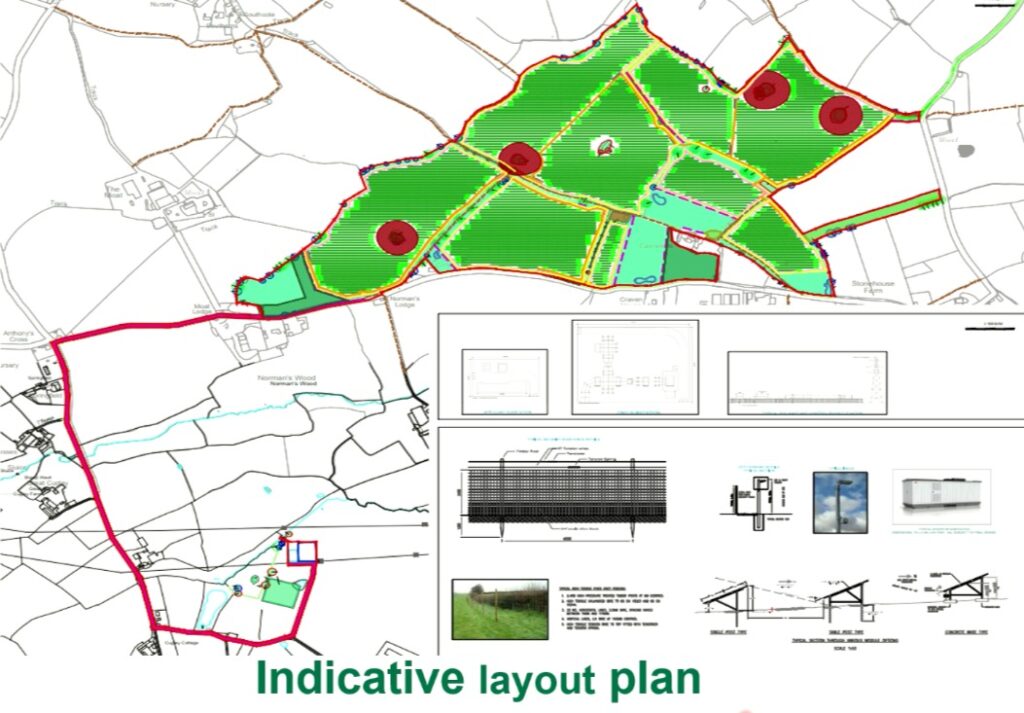
Elgin Energy EsCo Limited has been refused permission to go-ahead with the 49-megawatt solar installation at Moat Farm in Kent’s Green near Newent.
Forest of Dean District Councillors considered the proposals at the development management committee meeting on July 8.
Serious concerns were raised over the cumulative impact of large solar farms being built and planned for in the Newent area.
And residents have previously expressed concerns the new renewable energy sites would create a corridor of one million solar panels along the B4215 between the market town and Gloucester.
The developers said the 200-acre site would house the ground mounted photovoltaic panels for 40 years.
These panels would cover 162.6 acres of the whole site.
They said the proposals were in line with policies which support renewable energy at national and local levels to respond to the declaration of a climate change emergency.
And the development would make a substantial contribution to achieving the net zero goal and is fully compliant with local and national planning policy.
But there was strong opposition from residents as well as town and parish councils.
Newent Town Council said the scheme constituted overdevelopment and would overshadow neighbouring properties.
Town councillors also have road safety concerns and fear its construction would generate excessive traffic.
They also said the installation of solar panels on arable land that has been successfully used to grow crops for over 25 years.
Taynton Parish Council also objected to the “very large” solar farm. “With only about 10 rural farms of this size or greater operating in the UK it will, if granted, with two other ongoing applications, be the third in a small area.
“The cumulative visual impact will be too great. Output greatly exceeds local power demand meaning power will be exported to the grid via 132kV lines in the immediate area.”
They also said there was no local job creation.
And Hartpury, Rudford and Highleadon parish councils raised the prospect of at least 700 acres of farmland being dedicated to solar farms within a five to ten mile area; equivalent of around six full size golf courses.
Each of the three proposed solar farms identified would be among the largest five solar farms in England, they said according to the council report.

Councillor Patrick Kyne (L, Coleford) said it was a difficult decision as national and local. “No one wants them next to them,” he said. “This is a UK future energy needs issue.
“It’s a difficult one. And I’m sure I would be objecting if they were in the field next to me.” However, he said councillors had to look at the “bigger picture”.
Councillor Dave Tradgett (G, Longhope and Huntley) raised concerns about the substantial loss of agricultural land.
“We shouldn’t vote to lose that much resource locally, very near to some reasonable population centres like Newent and other towns in the Forest,” he said.
Councillor Gill Moseley (LD, Newent) said many solar farm developers are looking to build along the pylon line.
“It’s so often the case, when solar farm applications are considered that local people all complain why we don’t have solar panels on roofs of homes and commercial premises,” she said.
She said the committee must not overlook the cumulative effect of the nearby approved solar farm which covers 28 fields. “The cumulative impact of that would almost make us into ‘Solarshire, not Gloucestershire.”
Cllr Kyne said across the UK 0.1 percent of the land is covered in solar farms. “But in Newent, that may be different”, he said.
And Councillor Simon Phelps (I, Westbury-on-Severn) challenged the agricultural land assessment of the fields. He said it was a good agricultural land and councillors witnessed that on a site visit.
Cllr Phelps said he can remember those fields being used for wheat and barley many years ago.
“The field was growing good crop of rape seed oil,” he said.
“The quality of this land is acknowledged as being of superior quality. It is remiss of Defra to conduct these soil assessments properly.”
He also said the scheme would have a detrimental effect on the landscape and he moved that the proposals be rejected in line with the officer’s recommendation.
Cllr Phelps also said “alarm bells are ringing in Westminster” over the country’s capacity to grow its own food.
The committee voted to reject the proposals by eight votes to one with one abstention.