
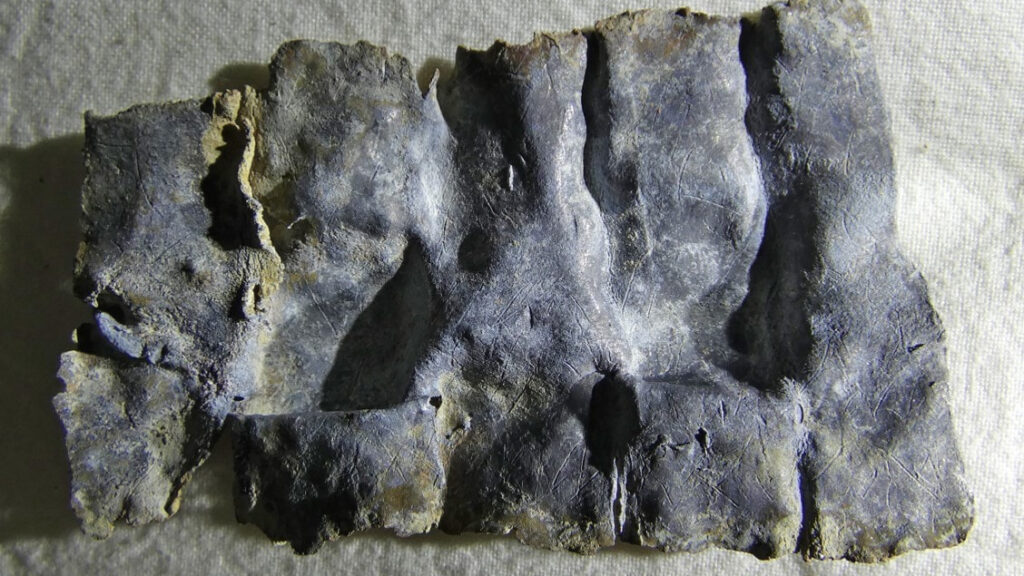
Visitors to the Corinum Museum in Cirencester will have an opportunity to view a rare set of Roman curse tablets from the Cotswolds for the first time when they go on public display.
The tablets have been loaned to the museum for five years by the Research I Library in the United States, which acquired them to support its ongoing research into the Roman world. The arrangement will allow visitors to experience these fascinating ritual objects up close and learn more about the beliefs and rituals of Roman Britain.
Curses were used by Romans in an attempt to influence the lives of others, particularly those who had wronged them. These messages were usually inscribed onto thin sheets of lead, which were then folded or rolled up and hidden in graves, buried in the ground, or cast into wells, springs and other sacred places to invoke supernatural intervention. It was believed that the curse would remain active for as long as the tablet stayed concealed.
The tablets are made from thin lead sheets that have scratches across the surface. The fact that they are small, and some were folded, makes them very difficult to translate.
But the trained eye and expertise of Professor Roger Tomlin from Oxford University has helped to unlock some of the tablets’ secrets. Professor Tomlin’s work has revealed that at least one curse is dedicated to the god Mercury, a deity widely worshipped in and around Roman Corinium. The curse concerns the theft of a cloak and appeals to the god for justice.
Professor Tomlin’s translation reads: “To the god Mercury Aruerius (from) [name lost]. I complain to you. Lord concerning my property, a cloak [and hood] Whoever stole this, whether slave or free, whoever stole this, the god is not to let them stand or sit, or drink or eat, unless they…you…with [their own blood.”
Emma Stuart, Director of Corinium Museum, said: “The curse tablets are the first example of this type of ritual artefact we have from the Roman period. Unlike the Roman Baths, we didn’t have any examples of curse tablets in our collection until the generous offer of a loan was extended by Research I Library.
“The Roman people scratching Latin into these tablets must have been educated even to a basic standard and, if nothing else, these objects are a wonderful example of Roman revenge.”
The lead tablets have been recently conserved and stabilised by the skilled team at Conservation and Museums Advisory Service (CMAS) who used raking light to enhance the lettering in recent photographs. The Cotswold Curse Tablets will be on very brief display at the Corinium Museum during the Cirencester History Festival at the end of October, before a special mount is made to display them in the main Roman gallery. A formal launch of the new display and rare artefacts will take place in 2027.
To coincide with the display during the History Festival, Corinium Museum will be running a children’s Halloween workshop to make your own ‘curse tablet’ on October 30 at 10.30am. The event is bookable through the Cirencester History Festival website.
Corinium Museum’s new opening times Monday to Sunday 10am to 4pm.