
By Carmelo Garcia – Local Democracy Reporter
It is likely several chief executives will be out of a job as a result of local government reorganisation in Gloucestershire but most council workers “actually delivering the services on the ground” will be protected.
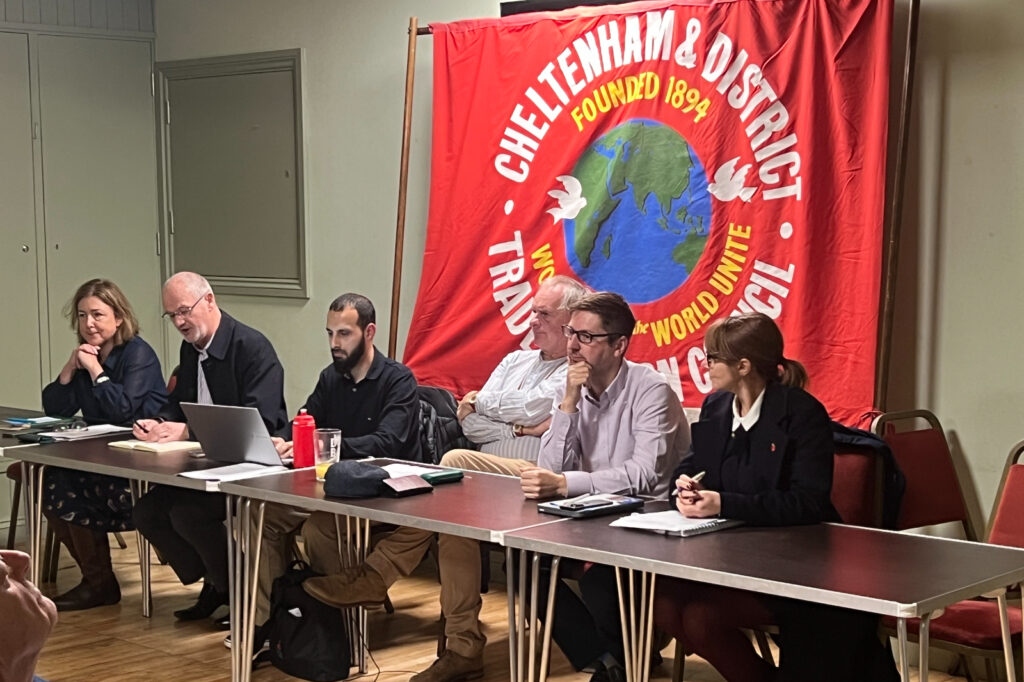
That is what a public meeting on local government reorganisation was told at the Gloucester Irish Club on Monday night (November 3).
Council leaders and MPs were invited to the meeting on the impending local government reorganisation which was organised by Gloucestershire Association of Trades Council.
It is likely that three options on how a council shake-up could unfold will be submitted to the Government later this month.
Gloucestershire County Council, along with the six district authorities, have worked together to come up with two proposals for how local government could be organised in the future.
These are for one single unitary authority, splitting the county into East and West with one council made up of Gloucester, the Forest of Dean and Stroud and the other composed of Cheltenham, Cotswold and Tewkesbury.
And a Greater Gloucester unitary council with a separate unitary for the rest of the county is being worked on by the City Council.
Council leaders Lisa Spivey (LD, Gloucestershire), Chloe Turner (G, Stroud District), Richard Stanley (LD, Tewkesbury Borough) were present and took questions from the public along with Shire Hall’s former Conservative leader Stephen Davies (C, Gloucestershire) and former Stroud District leader Steve Lydon who represented Labour.
Councillor Turner said Stroud District Council have been transparent and will keep staff as informed as possible as the local government reorganisation process goes forward.
“The only thing we really know about staff is that as we go into the new unitary or unitaries, the chief executives of the districts will no longer have a job but everything else will be a decision for the new authority or authorities to make,” she said.
“We can only do some transitional planning to support that process and make assumptions to feed into the financial models that we are working with at this.”
Cllr Davies said he shared the view that chief executives might be nervous about the changes as well as human resources staff but he believes AI poses more of a threat to jobs than local government reorganisation.
“If you are working in local government today and you are doing something that needs to be done, it is inconceivable that it won’t continue to happen,” he said.
“Unless of course, you end up with an east and west split and you have a deficit you need to make up, in which case there would have to be cuts in West Gloucestershire.
“Otherwise those jobs will still need to be done.
“I share the view that if you are a chief executive you might be nervous and there are probably some centralised departments like HR that might feel threatened.
“Personally, though, I think AI is a bigger threat than LGR in this marketplace.”
Neil Armitage, Unite Gloucester District branch official, said the trade unions wanted to know if employment, conditions and the quality of jobs and wages would be protected.
“My experience of working for two large corporations and having to be a rep in multiple redundancies is that when things are merged to get economies of scale, somehow, it seems that a lot of people at my sort of level get made redundant but the senior managers all seem to manage to find a place,” he said.
“Bear that in mind if you end up as a unitary authority.”
Cllr Stanley said it was a fair concern but he reassured the meeting that council workers providing services will be needed, valued and protected.
“Whether we’re looking at one unitary or two unitaries, ultimately, we aren’t going to need seven chief executives of the council,” he said.
“But those doing the work on the ground, those emptying the bins, those delivering services to our children, those planners, all of those, the challenge for local government has been recruiting and retaining, so the doers, those actually delivering the services on the ground, absolutely, I think we’re gonna be wanting to retain and look after them and keep as many of those people as possible.”
He said his understanding was that if there are any personnel savings they would be at senior level.
Cllr Spivey said the proposals will be put to the Government on November 28 but that is only the next step in the journey.
She said the council leaders and chief executives had agreed that whatever happens with the reorganisation that staff retain the same terms and conditions across both unitary authorities, should that option be chosen by ministers.
“That’s really important because we won’t control that decision because ultimately it will be for after the elections in May 2027 and it will be the new shadow authority or authorities who do that,” she said.
“So that will be for those leaders to decide what happens, but that is currently the working assumption.
“We’ve got to make sure that our staff are there, that they are working, that they will continue to deliver services. That’s the most important thing.
“Without the council staff and the wider union and other people working there then nothing can happen.”