
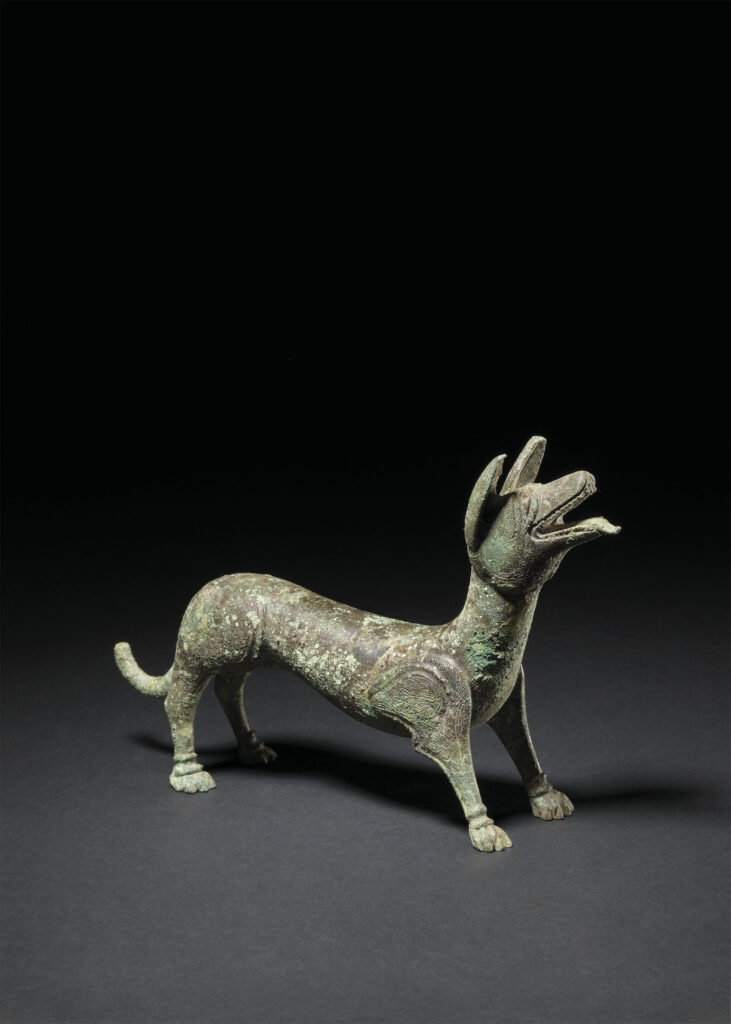
A rare Roman bronze statue known as the Licking Dog, dating from the 1st century A.D., will go on display and sale this weekend at Frieze Masters in London.
The extraordinary piece will feature on the stand of leading antiquities specialist David Aaron Gallery.
Archaeologists say the bronze, discovered in Gloucestershire in 2017, is unique — with no known parallel in Roman Britain either for its size or the richness of its decoration.
The figure was the only intact item uncovered within a sizeable hoard of Roman bronze artefacts, which otherwise consisted entirely of fragments. Complete bronze statues from the north-western provinces of the Roman Empire are exceptionally rare.
The statuette depicts a dog standing alert, head raised and tongue extended as if licking. Its body is intricately engraved with chevron and feather motifs, and incised to mimic the texture of fur.
In the ancient world, dogs were believed to have healing powers, often associated with the Roman god Mars and the Greek god of medicine, Asclepius. Statues of “licking dogs” were dedicated to the Celtic healing god Nodens, whose temple stood at Lydney Park, Gloucestershire — not far from where this piece was unearthed.
Though similar figures have been found at Lydney Park and Llys Awel, this example stands apart in scale and craftsmanship, making it one of a kind in Britain’s archaeological record.